Thursday, 17 July 2014

12. Gone with the Wind (1939)

Director: Victor Fleming

Starring: Vivien Leigh, Clark Gable,  Leslie Howard, Olivia de Havilland

Other Oscar Wins: Best Actress in a Leading Role (Vivien Leigh), Best Actress in a Supporting Role (Hattie McDaniel), Best Director, Best Writing, Best Cinematography, Best Art Direction, Best Film Editing

Other Oscar Nominations: Best Actor in a Leading Role (Clark Gable), Best Actress in a Supporting Role (Olivia de Havilland), Best Sound, Best Effects, Best Score

Favourite Line: "If I have to lie, steal, cheat or kill. As God is my witness, I'll never be hungry again."
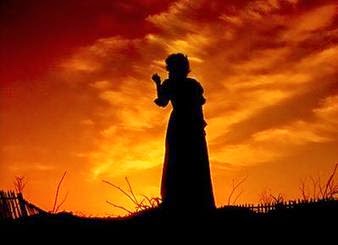
Vivien Leigh in Gone with the Wind.
Gone with the Wind, rated by the American Film Institute as the 6th Greatest Movie of All Time, and also the top grossing movie of all time (if adjusted for inflation), is an incredible picture with very compelling storytelling, and is just so enormous that it is hard not to be in awe of the film.

This is the story of the manipulative and selfish southern belle, Scarlett O'Hara, whose world is turned upside down by both the American Civil War, and the marriage of her beloved Ashley to another woman. 

First and foremost, Gone with the Wind is one of the most beautiful movies I have ever seen. The cinematography is absolutely brilliant, and every shot is simply stunning, and it is well deserving of it's own Oscar. The most impressive moment of the film for me, is when Scarlett is looking for a doctor to help with Melanie's baby, and she walks through a field of hundreds of injured confederate soldiers. The shot really hits home the scale and brutality of the war that surrounds these characters.

Art by Olly Moss
As for acting, Vivien Leigh steals the show as Scarlett herself. You can see every thought and feeling that comes to Scarlett across her face, and she draws you in, despite being a rather dislikable character. She rightly earned her Oscar as well. 

A few interesting facts. Gone with the Wind has a few firsts, including being the first colour film to win Best Picture at the Academy Awards, and it is also the first film in which an African-American (Hattie McDaniel) was both nominated for and won an Academy Award. Despite Hattie McDaniel's achievement, she, along with the other African-American cast members, could not attend the film's premier in the very segregated Atlanta. Another interesting fact is that because of the Hollywood Production Code, the film's producer was fined $5,000 for swearing in what became one of the most famous movie lines of all time- "Frankly my dear, I don't give a damn".

Gone with the Wind is a wonderful film, which should be seen by all.

Friday, 11 July 2014

11. You Can’t Take It with You (1938)

Director: Frank Capra

Starring: Jean Arthur, James Stewart, Lionel Barrymore

Other Oscar Wins: Best Director

Other Oscar Nominations: Best Actress in a Supporting Role (Spring Byington), Best Writing, Best Cinematography, Best Sound, Best Film Editing

Favourite Line: "Well, maybe I am, but I used to be just like you once. Then one morning, when I was going up in the elevator... it struck me I wasn't having any fun. So I came right down and never went back. Yes, sir. That was 35 years ago."
A scene from You Can't Take It with You.

 Frank Capra's You Can't Take It with You is a charming comedy of a rich young man who falls in love with a middle class girl with an eccentric family. When the families meet for dinner, chaos ensues, and neither likes the other very much.

This was a rather enjoyable film with a wonderful cast including the incomparable James Stewart and Lionel Barrymore. Lionel Barrymore plays the Grandfather of the Sycamore family, who believes that the important things in life are friendship and having fun. It is his endearing and lovely performance that ties the whole film together and who drives the story. His performance certainly stood out for me, and he did an absolutely wonderful job of his role.
Art by Olly Moss.

A couple interesting facts about You Can't Take It with You. Shortly before filming, Lionel Barrymore was unable to use his legs due to arthritis and a hip injury, and so the script was changed to say that Grandfather had sprained his ankle riding down the banister, and Barrymore did the film on crutches. Another interesting fact is that Ann Miller, who plays Jean Arthur's dancing sister, was required to wear ballet pointe shoes several times during the film. She was only 15 at the time and the shoes were very painful, so she would hide and cry between takes. James Stewart found her, not knowing why she was crying, but would offer her boxes of candy to cheer her up.

All in all, You Can't Take It with You is a lovely film about camaraderie and living life in a way that makes you happy.

Thursday, 3 July 2014

10. The Life of Emile Zola (1937)

Director: William Dieterle

Starring: Paul Muni

Other Oscar Wins: Best Actor in a Supporting Role (Joseph Schildkraut), Best Writing (Screenplay)

Other Oscar Nominations: Best Actor in a Leading Role (Paul Muni), Best Director, Best Original Story, Best Art Direction, Best Sound, Best Assistant Director, Best Score
Paul Muni and Vladimir Sokoloff in The Life of Emile Zola.

Favorite Line: "I shall tell the truth. Because if I did not, my nights would be haunted by the spectre of an innocent man expiating under the most frightful torture a crime he never committed."

The Life of Emile Zola is the fictionalized story of the life of the French writer, Emile Zola. 

I'm afraid I don't have a lot to say about this film. I personally did not find it very interesting at all, and it was very difficult to get through to the end. Its not that the film isn't well done or even that the acting is bad, in fact it is a well done film, but it is simply not very interesting.

Art by Olly Moss.
I have to say that I was surprised that Paul Muni did not win the Oscar for Best Actor for his portrayal of Emile Zola himself. He does an absolutely incredible job, especially of portraying the same man at multiple stages of his life.

The Life of Emile Zola is a well done film, just not one particularly fascinating to me. 


Tuesday, 17 June 2014

9. The Great Ziegfeld (1936)

Director: Robert Z. Leonard

Starring: William Powell, Myrna Loy, Luise Rainer

Other Oscar Wins: Best Actress in a Leading Role (Luise Rainer), Best Dance Direction

Other Oscar Nominations: Best Director, Best Writing, Best Art Direction, Best Film Editing

Favourite Line: "I've got to have more steps. I need more steps. I've got to get higher. Higher."

A scene from The Great Ziegfeld.
The Great Ziegfeld is an absolutely visually stunning film about the life of Florenz Ziegfeld Jr, and his relationships with his first wife, Anna Held, and his second wife, Billie Burke.

First and foremost, The Great Ziegfeld is absolutely gorgeous. The costumes, designed by Adrian, are absolutely fabulous, and the art direction by Cedric Gibbons and Eddie Imazu is definitely deserving of it's Oscar nomination. The "A Pretty Girl is like a Melody" scene (pictured here), which is definitely the most extravagant scene in an already very extravagant movie, was actually shot in one continuous take, and it took weeks to rehearse and months to build. The scene includes 180 performers, 4300 yards of rayon silk for the curtains alone, and it cost $220,000.

Art by Olly Moss
The acting in the film is also superb from all the leads. William Powell is wonderful as Ziegfeld, and is so genuine and endearing in his role that you can't help but feel for him throughout the film. Luise Rainer as Anna Held certainly deserved her Academy Award for Best Actress in a Leading Role. It is impossible to take your eyes off her whenever she is on screen. 

 A few interesting facts about The Great Ziegfeld. The real Billie Burke was quite involved in the writing of the screenplay. She took special care to make sure that the writers never besmirched the name of Ziegfeld. Despite her interest in the writing, it is said that she didn't care too much for the film in the long run. I also found it interesting that Myrna Loy, who portrays Billie Burke in the film, is given second billing, even though she does not appear on screen until 2 hours and 15 minutes into the film.

Overall, The Great Ziegfeld is a beautiful movie and is certainly a film worth watching.

Tuesday, 10 June 2014

8. Mutiny on the Bounty (1935)

Director: Frank Lloyd

Starring: Charles Laughton, Clark Gable, Franchot Tone

Other Oscar Wins: N/A

Other Oscar Nominations: Best Actor in a Leading Role (Clark Gable), Best Actor in a Leading Role (Charles Laughton),  Best Actor in a Leading Role (Franchot Tone), Best Director, Best Writing, Best Film Editing, Best Score

Favourite Line: "I'll live to see you - all of you - hanging from the highest yardarm in the British fleet!"
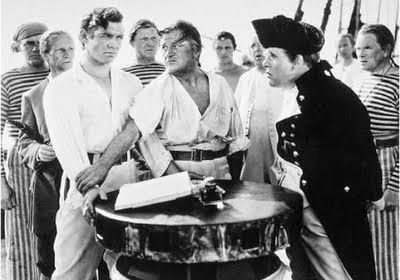
Clark Gable and Charles Laughton in Mutiny on the Bounty.

 Frank Lloyd's Mutiny on the Bounty is an extravagant epic of the high seas, where it's cruel and selfish captain is cast ashore with some of his loyal crew. He vows to see the mutineers hung, and against all odds, reaches shore, and sees his vow fulfilled.

Although Mutiny on the Bounty is quite visually impressive and has quite an astounding scale, which makes the film worthy of it's acclaim, I find it a very difficult film to sit through. It is very long, and perhaps this is just my personal preference, but I don't find it very interesting.

Art by Olly Moss
All three lead actors very much deserved their Best Actor nominations, as they all did incredible jobs of their roles, and the set and costumes are all beautiful. The ship itself is very impressive, and all this should make for a great film, but I found myself getting very bored throughout. 

A couple interesting facts about Mutiny on the Bounty. Clark Gable was required to shave off his signature moustache in order to preserve the historical accuracy of the film. During the time that the film takes place, moustaches were not allowed in the Royal Navy. My second interesting fact is that Charles Laughton, playing the cruel captain of the Bounty, was sea-sick for a lot of the filming, despite playing such a skilled seaman. 

Overall, Mutiny on the Bounty is a very impressive film, but not one I personally found very interesting.


Tuesday, 27 May 2014

7. It Happened One Night (1934)

Director: Frank Capra

Starring: Clark Gable, Claudette Colbert

Other Oscar Wins: Best Actor in a Leading Role (Clark Gable), Best Actress in a Leading Role (Claudette Colbert), Best Director, Best Writing

Other Oscar Nominations: N/A

Favourite Line: "I'll stop a car, and I won't use my thumb!"

Claudette Colbert and Clark Gable in It Happened One Night.
Frank Capra's It Happened One Night is a wonderful romantic comedy with brilliant writing and acting. It is a thoroughly entertaining piece which had me laughing and intrigued the whole way through.

It Happened One Night is the story of a rich girl who marries against her father's wishes, and when he threatens to annul the marriage, she runs away to New York. On the way she meets a newspaper reporter who decides to help her. The two eventually fall in love, despite the girl's previous marriage.

I am already a fan of director Frank Capra, as his film It's a Wonderful Life is one of my all time favourites. The writing is simply hilarious and charming, with very compelling storytelling. Clark Gable and Claudette Colbert are both incredible as well, with wonderful chemistry. It is said, however, that neither of the leads liked the film at all. On Clark Gable's first day on set, he reportedly said "Let's get this over with", and on the last day of filming, Claudette Colbert told a friend, "I just finished making the worst picture I've ever made." Despite the stars dislike of the film, they both did a wonderful job, and the film is very enjoyable.

Art by Olly Moss.
A few fun facts about It Happened One Night- it is one of three movies to win every Oscar for which it was nominated, including Best Picture. The two other films to achieve this are The Last Emperor (1987) and The Lord of the Rings: The Return of the King (2003). The other fun fact I found about It Happened One Night, is in the scene where Clark Gable starts undressing. He originally had an undershirt on in the scene, but in every take it took too long to take off and it interrupted the flow of the scene. Eventually the decided to get rid of the undershirt, and as a result, the sales of undershirts in the US dropped considerably. It is said that some underwear manufacturers tried to sue Colombia because of this.

It Happened One Night is a very entertaining film, and I will certainly be watching it again. I would highly recommend it to anyone looking for a good comedy.

Thursday, 22 May 2014

6. Cavalcade (1933)

Director: Frank Lloyd

Starring: Diana Wynyard, Clive Brook

Other Oscar Wins: Best Director, Best Art Direction

Other Oscar Nominations: Best Actress in a Leading Role (Diana Wynyard)

Favourite Line: "A great adventure, Robert. Anxious sometimes, and sad. Sometimes, unbelievably happy. And thank God, never dull or sordid."

A scene from Cavalcade.
Cavalcade is the story of a well to do British family at the turn of the century, beginning with New Years Eve 1900, up to New Years Eve of 1933, which was the present at the time of the film's release. The family has sees their share of hardships, from father fighting in the Boer War, to the eldest son and his wife drowning with the Titanic, to the youngest son, Joe, falling vicim to the Great War. Based on the play by Noel Coward, Cavalcade  is a beautiful and touching film with an immense scale. I found it to be very well done.

The costuming and set decoration in this film was exceptionally outstanding to me, and it is no wonder it won the Oscar for Best Art Direction. The costume department would have had an absolutely massive undertaking, having to clothe not only the lead actors but also many, many extras in 33 years worth of styles, and those 33 years had so much variety in fashion. Visually, the whole film was stunning.

Art by Olly Moss.
I was also very impressed by all of the actors in this film, so much so that I can't single any of them out. This is likely due to the sheer brilliance of the script. Mind you, as someone who studies Theatre at a post-secondary level, I am a little biased in Noel Coward's favour. Two particular moments in the film that were exceptional to me, however, were firstly, the Twentieth Century Blues song, sung by the character of Fanny near the end of the film. It was so simple, and yet so profound. After all that has happened, it just seemed the perfect finish, summing up the whole story. The other moment I loved was Edward and Edith's honeymoon. Before the scene even begins, the date is shown on the screen. A day we know to be the sinking of the Titanic. Then we see Edward and Edith on a ship, and so the viewer is already uneasy. Then they begin to talk about death and how they would be comfortable to die now while they are happy and before they fall out of love with each other. At the very end of the scene it is revealed that the ship is indeed the Titanic, which causes the scene to be so incredibly sad, and yet bittersweet in a way, because of the conversation just before. It's heartbreaking and so brilliantly done.

Cavalcade  is a wonderful film and quite deserving of it's Oscar, despite it being widely unknown. It is worth searching out and seeing.